
At 61, James Stewart, Managing Director of Longthorne Gunmakers, speaks about his role with characteristic directness: “I’m the person who is ultimately responsible for everything, good and bad.” It’s a simple statement, but one that reflects decades of leadership, innovation, and unwavering commitment to precision engineering.
Born and raised in Lancashire, England, Stewart has been at the helm of Longthorne since 2010. Over that time, he has helped shape the company into one of the most technically progressive names in modern gunmaking. Among his proudest achievements is the development of Longthorne’s signature one-piece barrel technology, an innovation that has redefined performance standards while preserving the elegance expected of a fine British gun. “Designing our one-piece barrels and subsequent models,” he notes, “and still being here” are milestones he considers particularly meaningful.
Stewart’s path into gunmaking was anything but conventional. Before focusing on firearms, he worked on a wide range of engineering projects, from developing a medical prosthetic device for a Japanese company that helped paraplegics walk, to designing high-end bicycle components sold across Australia. That breadth of experience laid the foundation for his approach today, one that seamlessly blends engineering innovation with traditional craftsmanship.

“At Longthorne, we don’t see tradition and innovation as opposing forces, they are complementary,” Stewart explains. “Traditional gunmaking provides the foundation… the look, feel, and craftsmanship must still resonate with that heritage. Where we differ is in how we achieve it.” By using modern engineering to improve precision, consistency, and reliability, while retaining hand-finishing for character and individuality. Longthorne strikes a careful balance. As Stewart puts it, “We use modern technology to perfect the unseen, and traditional craftsmanship to define what is seen and felt.”
Maintaining those standards, however, comes with its challenges. “True craftsmanship cannot be rushed,” he says, pointing to the constant tension between production timelines and uncompromising quality. External pressures, including infrastructure setbacks such as flooding in 2024, have tested the company’s resilience. Yet Stewart remains firm in his philosophy: “Rather than outsource or dilute our process, we chose to absorb the delays and maintain full control over quality because that is fundamental to who we are.”
Innovation itself presents another challenge. Longthorne’s continued development often places the company at the cutting edge of what is technically possible. “We are often working at the technological knife edge,” Stewart admits, requiring constant testing and refinement. Alongside this is the need to invest in skilled craftsmen, ensuring that the human element remains as strong as the engineering.
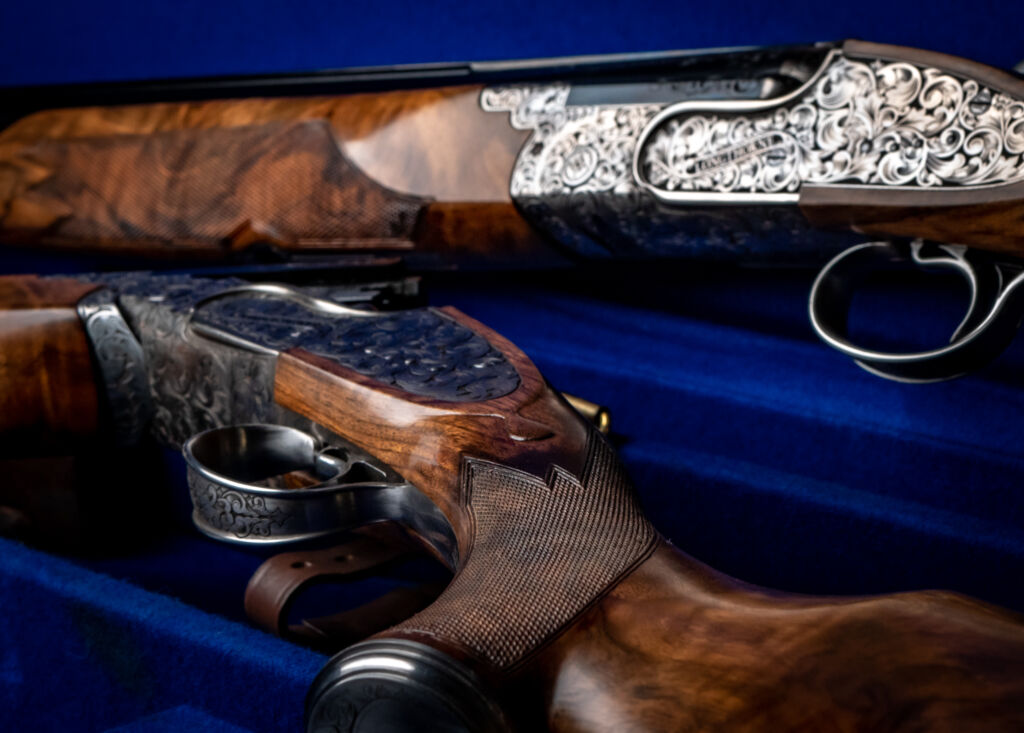
Looking ahead, Stewart sees a clear path for artisan gunmaking. “The future lies in the balance between heritage and innovation,” he says. While much of the industry has moved toward mass production, he believes there is a growing demand for authenticity and individuality. “Discerning clients are increasingly seeking pieces that are not only functional but meaningful – guns with a story, made by identifiable craftsmen.”
For Stewart, the future will also be shaped by advances in materials and sustainability, as well as a continued commitment to quality over quantity. “Artisan gunmaking will remain a niche,” he reflects, “but a highly valued one.”
Away from the workshop, Stewart maintains a disciplined personal routine, often training in the company’s in-house gym alongside colleagues. His current goals—bench pressing 140kg and deadlifting 240kg, mirror the same mindset he brings to his work: constant improvement and pushing boundaries.
If stranded on a deserted island, his choice of firearm is as pragmatic as it is personal: “A Longthorne Titanium with a stainless steel action. It would be less likely to corrode due to salt, and it’s nice and light to carry.”
Stewart also credits his early inspiration to his high school Head of Engineering, William Irlam, who nurtured his passion for engineering and remained a lifelong influence. “He took me under his wing… and became a great friend,” Stewart recalls.
Today, that early passion continues to drive him. Whether developing new technologies or refining traditional techniques, his focus remains unchanged: to push the boundaries of what a fine gun can be, without ever losing sight of the heritage that defines it.
Visit World Gunmakers’ Evening to see the new Longthorne Foxcote model, steel and titanium models and Peregrine Barrels.
